Mars released its 2026 Tricks, Treats and Trends Report this month, an eleven-slide summary of a Morning Consult survey on how Americans approach Halloween. It is a candy company’s research, and most of it is about candy.
But four of the six headline findings describe behavior that haunted attractions are already selling, and one of them is a number I have wanted for a long time.
First, the caveat
The survey ran June 1 through 5, 2026, online, through Morning Consult, with 3,001 US adults 18+, weighted to be nationally representative, with a stated margin of error of 2 percent.
Three thousand people is a real sample. It is not a massive one, and it is not an industry study. Mars sells Halloween candy, and a report finding that Halloween is bigger, longer, and more emotionally significant than you thought is a report that serves Mars. Read it that way.
That said, the numbers below are worth having, because HAN has never had them, and in several cases they put a figure on something operators have only been able to describe anecdotally.
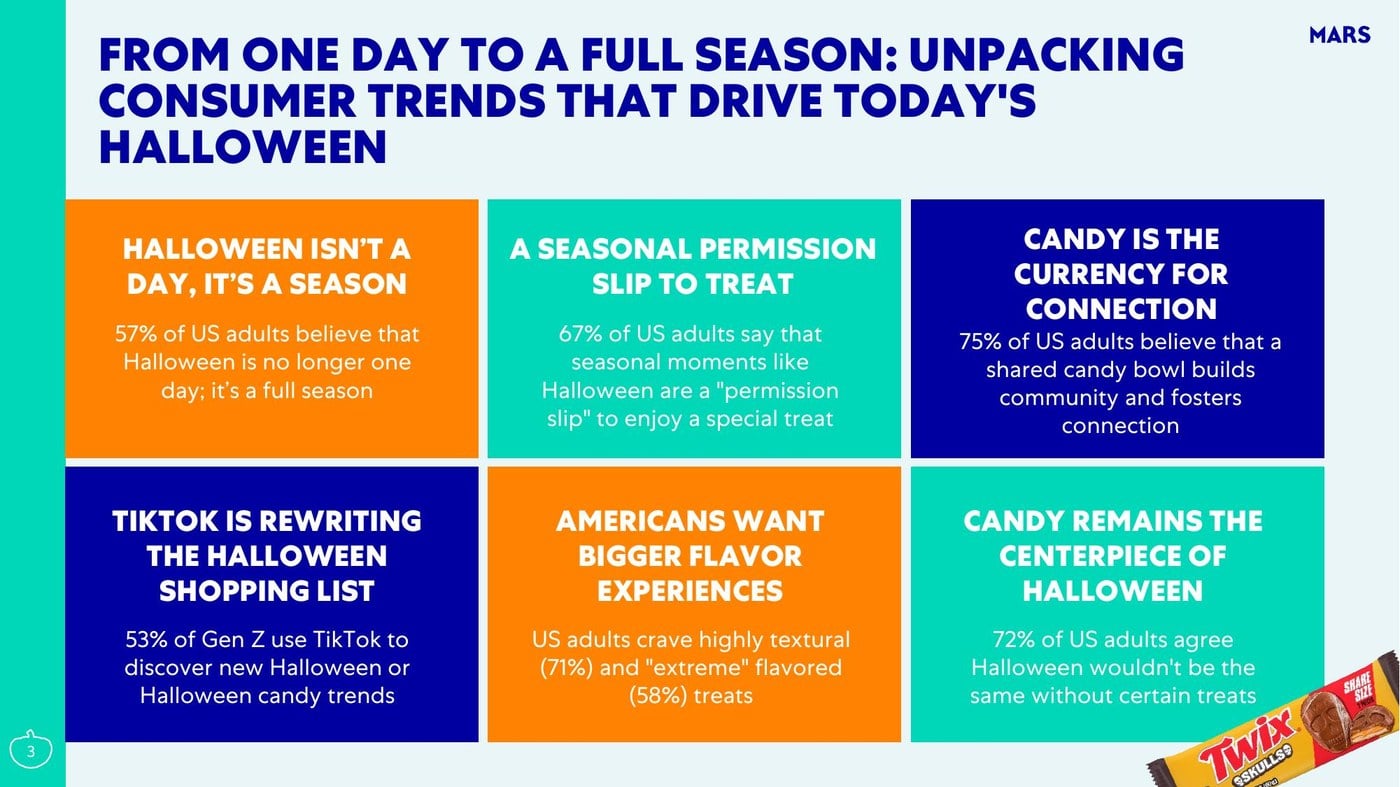
“Halloween is no longer one day; it’s a full season” — 57%
This is the finding that matters most to this industry, and it is the one I would put in a deck if I were pitching an investor or a landlord.
57% of US adults say Halloween is no longer one day but a full season. 66% say they would buy their favorite Halloween candy year-round. And Mars gives the phenomenon a name it did not invent but has now put numbers behind: Summerween.
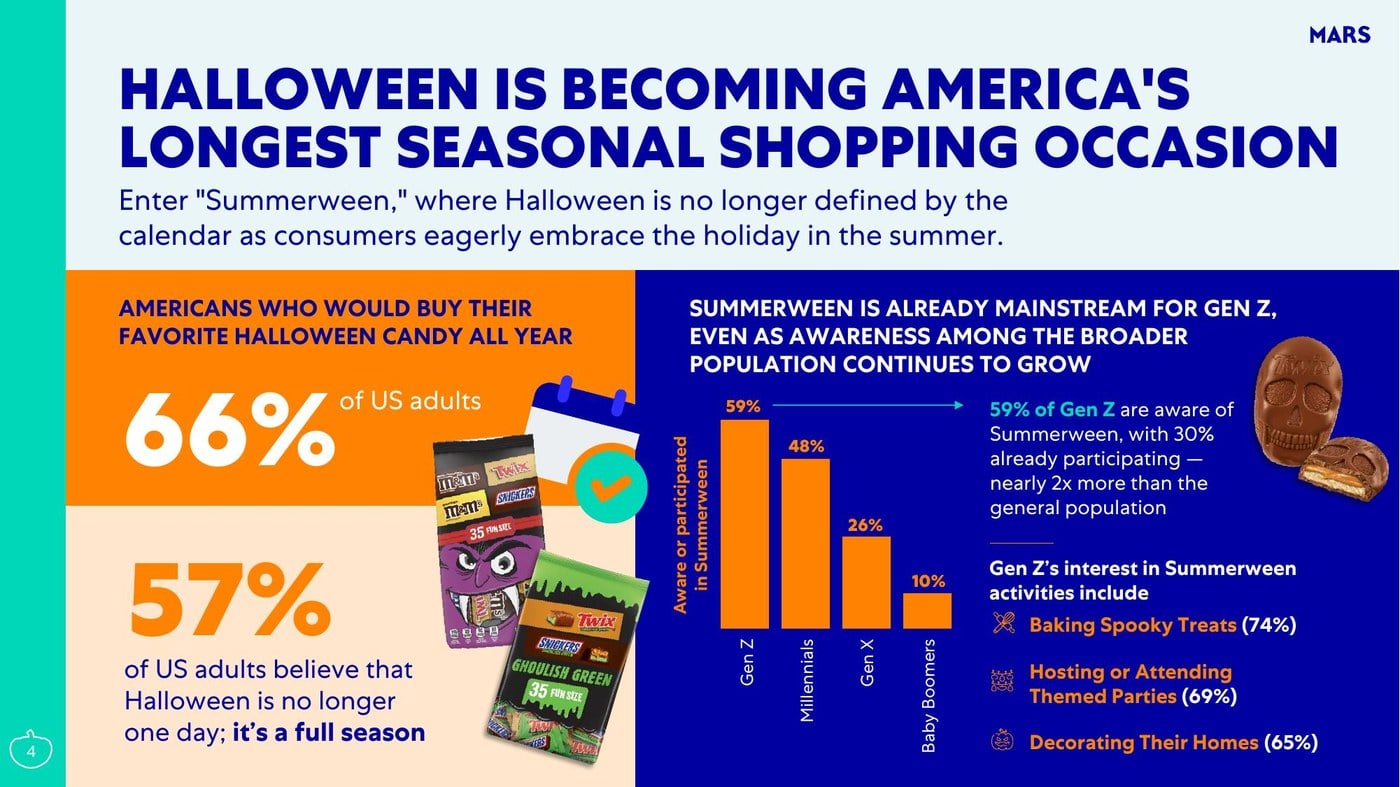
The generational split is the useful part. 59% of Gen Z are aware of Summerween, and 30% already participate — nearly twice the general population. Awareness drops to 48% for Millennials, 26% for Gen X, and 10% for Baby Boomers. Gen Z’s stated Summerween interests are baking spooky treats (74%), hosting or attending themed parties (69%), and decorating their homes (65%).
We have been documenting the operator-side version of this all summer without a consumer number attached to it. Mickey’s Not-So-Scary opens August 7, the earliest in its history. Halloween Horror Nights Orlando opens August 28, also its earliest ever. SCREAM-A-GEDDON opens August 29, the earliest independent haunt in the country. On the retail side, Home Depot went live July 16, LEGO opened Mayor Manor pre-orders July 11, and At Home dropped 1,000-plus pieces on July 25.
What the Mars number adds is that the audience says it wants this. That is a different argument than “our competitors did it.”
The two operators this most directly validates are ones we covered this month. ScareHouse is running Halloween Hangout as a month-long October takeover of an outdoor venue in Pittsburgh, with no traditional haunted attraction in year one. And Universal Horror Unleashed is operating 365 days in Las Vegas. Kim Scott, the venue’s senior director and general manager, framed the advantage exactly this way: “Where the parks have this finite amount of time, the interest that is coming to us is just phenomenal because we’re three sixty-five.”
I remain skeptical that a walk-through haunt is a year-round product, and I have written that at length. A 57% consumer belief that Halloween is a season does not mean 57% of consumers will buy a haunted house ticket in February. But it does mean the season is defensible far outside October, and that operators pushing into August and November are following demand rather than manufacturing it.
There is also an antecedent in our own archive that predates all of this. In 2019, Amy Hollaman, then at Terror Behind the Walls, told me: “When I was a kid, Halloween was one night, and it was sad when it was over. Now we can have Halloween for a bunch of nights! I love that this industry has taken a holiday from one night to 30.” That was seven years before Mars put 57% on it.
Sensory and flavor — 71% and 58%
Here is the finding I think is most actionable and least likely to be acted on.
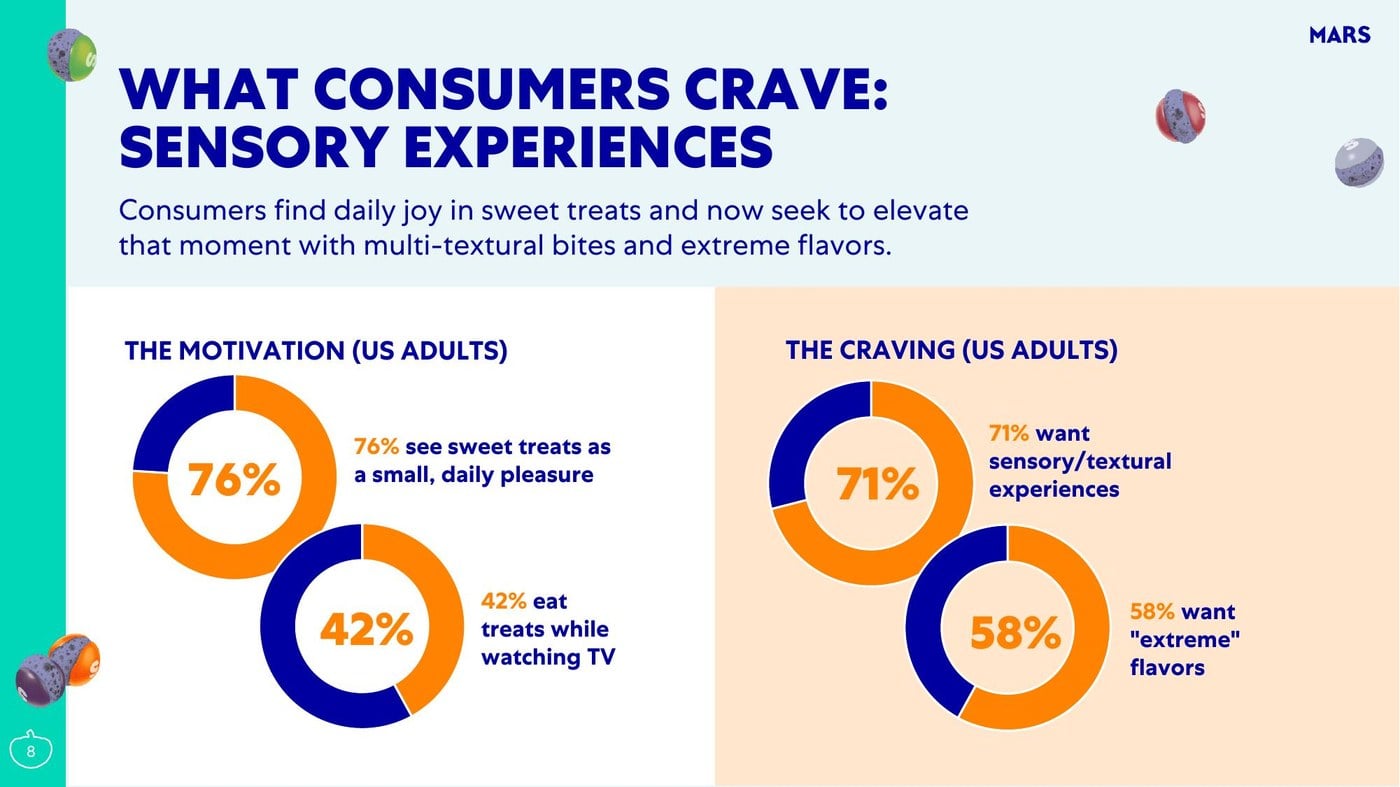
71% of US adults want sensory or textural experiences in their treats. 58% want “extreme” flavors. 76% see sweet treats as a small daily pleasure. And 67% say they actively seek out seasonal flavors, colors, or shapes when they snack — 74% among Gen Z.
Mars means candy. But that appetite does not stop at the candy aisle, and the attractions industry has a documented gap here.
From our reporting on Scarehouse Windsor’s immersive dinner, the numbers are stark: 65% of haunted attractions charge less than $30 for general admission (2024 Haunt Industry Report), fewer than 10% incorporate food at all (2022 Haunt Industry Benchmark Survey), and only 3.9% cite food as a major revenue source. Meanwhile regional theme park per-caps run $56.50 and destination parks $170.
Scarehouse Windsor’s package is $125 per guest. Co-owner Shawn Lippert broke it down for us: “It ends up being around $45 for the meal and $55 for your fast pass, which is our normal price.” The part worth underlining is not the margin, it is the audience:
“We’re attracting people that would never be caught dead in a haunted house. They come for the dinner and end up loving the haunt as well.” — Shawn Lippert, Scarehouse Windsor
That is a customer acquisition channel, not a concession stand.
The same logic is showing up at larger scale this season. SCREAM-A-GEDDON just spent $2.5 million rebuilding its midway into a 50,000-square-foot environment with four new food trucks, fire pits with s’mores, and an expanded beer garden — none of which adds a scare, all of which extends dwell time. At Eastern State Penitentiary’s Halloween Nights, director Erin Davis described the payoff plainly:
“There are so many people that would come up to me and say, ‘We can’t come because it’s too scary.’ And now I get to say, ‘Well actually, there’s something for everyone.’ You don’t have to do the scary stuff. You can just be entertained and have drinks and food and enjoy your night in that way.”
And in the broader attractions world, I wrote about this in May for Seasonal Entertainment Source after an IAAPA panel where operators were asked whether the F&B trend was sweet, savory, or experiential. All three answered experiential. Tommy Schatz-Thompson of Meow Wolf Grapevine described treating F&B “not as a secondary amenity, but a core element of the narrative for our entire site.”
The Mars finding says the consumer appetite for texture and intensity is there, at 71% and 58%. Our own industry data says fewer than one in ten haunts are set up to sell into it. That is the widest gap between demand and supply in this report.
One caution: “extreme flavor” is a candy category. The haunt version is not a hotter hot sauce. It is the thing Ocean Park’s Joel described to us years ago — “they don’t want to buy a churro. They want a Pumpkin Spice Limited Edition Churro, and they’re willing to pay $8 for it.” Specificity and theme, not shock.
“Halloween wouldn’t be the same without certain treats” — 72%
72% of US adults agree that certain candy brands feel like Halloween, and the holiday would not be the same without them. 75% say a shared candy bowl builds community. 71% believe the candy they hand out says something about them as a host. 72% say handing out full-size bars makes you the favorite house on the block.
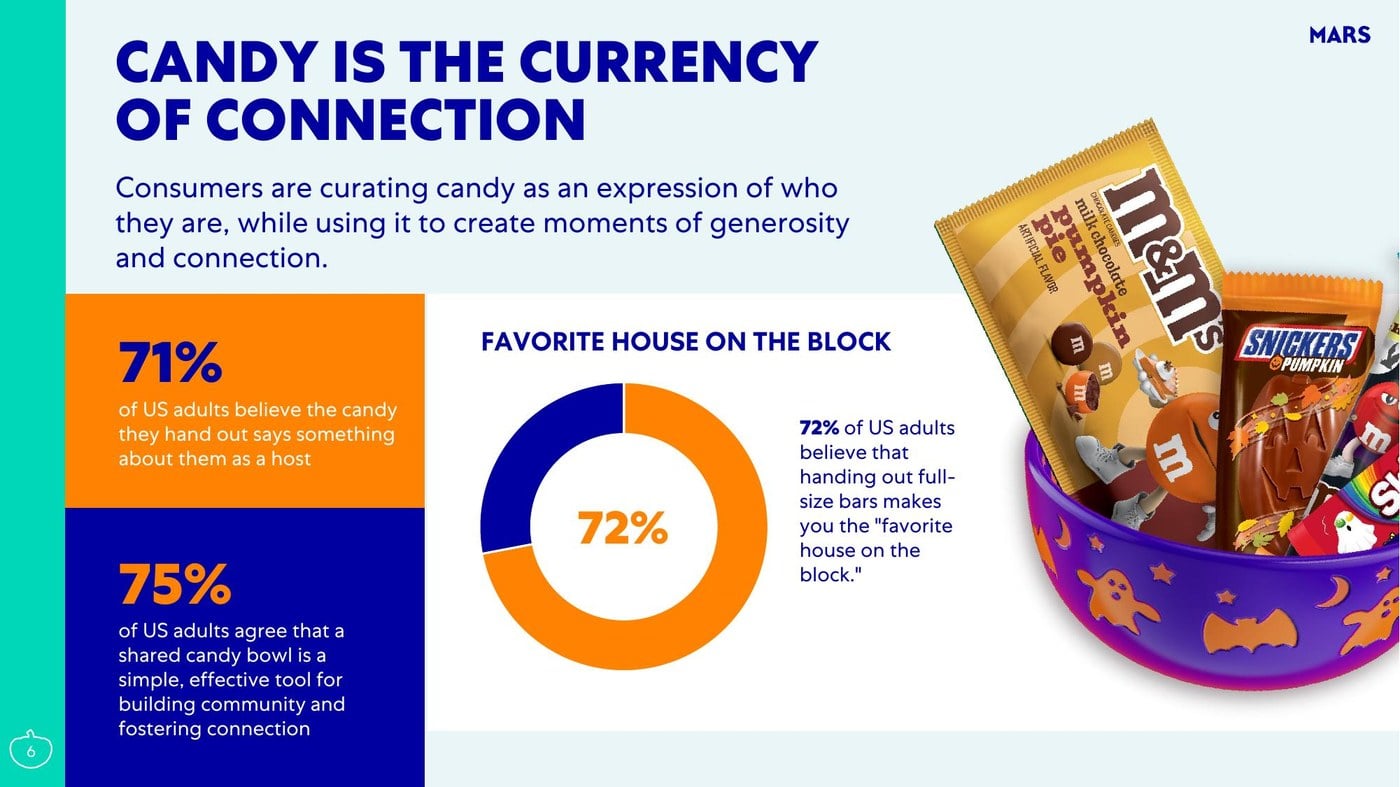
Strip out the brand-preference framing and what is left is a finding about ritual and reciprocity — people want to give and receive treats, and they attach identity to it.
The events already serving that for adults are some of the most reliably sold-out things we cover. The Spooky Swap Meet at Heritage Square Museum has sold out every day since its 2021 debut and now runs 65-plus vendors across three days, with guests of all ages trick-or-treating at seven Victorian-era homes decorated by professional haunt designers. Co-creator Claire Dunlap told me why in 2021, and I have never forgotten the phrasing:
“We all need to be able to trick or treat, not just kids. It’s a little discriminatory that only children get to trick or treat.” — Claire Dunlap, Spooky Swap Meet
Cemetery Lane built a 13-stop trick-or-treat route through the same Victorian row. Midsummer Scream’s Black Cat Lounge sells a premium tier explicitly described as “how adults trick or treat” — five miniature craft cocktail tastings paired with curated French chocolate truffles, starting at $90. That is the 72%, the 71%, and the 58% all in one ticket.
Scott Swenson made the underlying argument to me back in 2019: “When we grew up, we wanted ways to catch that same spark in a bottle. That’s why adult-theme haunted attractions work incredibly well. It’s an elegant way for grownups to capture that same feeling they had when they were kids.”
If your event ends at the exit and the only thing a guest carries out is a photo, you are leaving the reciprocity instinct on the table. A candy hand-off at the exit costs almost nothing.
Social discovery — 53% TikTok, 49% YouTube
53% of Gen Z use TikTok to discover new Halloween or Halloween candy trends. 49% use YouTube. 48% discover through general social browsing. But when they buy, they buy in person — 43% at large retailers, 41% at supermarkets, only 18% online from a retailer’s site and 10% through TikTok Shop.
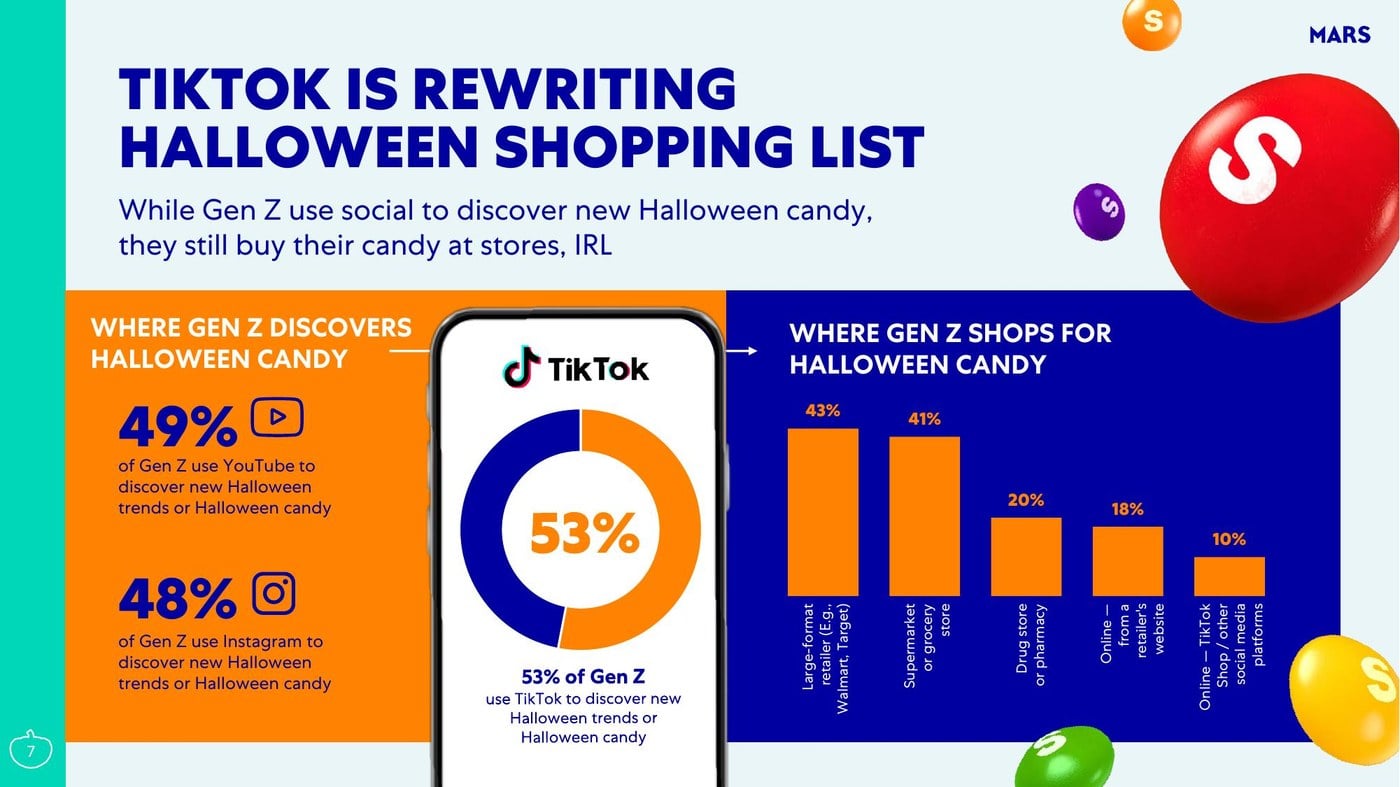
We have talked about social discovery for years without a number attached. This is the first generational platform-share data I have seen for this holiday, and I want to flag two things about it.
First, discovery and purchase are separate venues. Gen Z finds it on TikTok and buys it at Target. Applied to haunts, that means your TikTok is not a ticket-sales channel, it is a demand-generation channel, and measuring it on last-click attribution will make it look like a failure. Josh Sumsion of Dead City Haunted House described the actual mechanism to us in 2020 after a video hit three million views: “I wish we had a better way to track exactly who came in specifically through TikTok, but it was at least one group every 10 minutes or so would mention that they were here to see Jack Frost.”
Second, YouTube at 49% is nearly tied with TikTok, and almost nobody in this industry is treating it that way. Vertical short-form has absorbed most of the attention. That is a near-even split the report just handed us.
The retail example everyone in this industry should study is Home Depot’s $2.98 Halloween bucket, which went viral on TikTok last September, is in-store only, cannot be bought online at all, and now resells on eBay at roughly triple retail. Discovery on social, purchase in the aisle, scarcity doing the rest. That is the Mars finding rendered as a $3 product.
What I would actually do with this
Four things, in order of how cheaply you can act on them.
Put a treat in the guest’s hand on the way out. The 72% and 75% findings say the exchange itself carries weight. This is the lowest-cost item on the list.
Audit your food against “seasonal, textural, specific.” Not more food. One item that is unmistakably yours and unmistakably October. Fewer than 10% of haunts do food at all, so the bar for standing out is on the floor.
Split your social measurement. Stop asking whether TikTok sold tickets. Ask whether people arrive already knowing your characters. And put something on YouTube, because 49% of Gen Z is there and your competitors are not.
Use the 57% when you negotiate. With a landlord, a city, a sponsor, or a partner venue, “57% of US adults believe Halloween is a full season” is a citable line from a Mars-funded, Morning Consult-fielded, nationally representative survey. That is a stronger argument for a longer permit window than anything this industry has previously been able to point at.
What the report doesn’t tell us
Worth naming, since it shapes how far you can push these numbers.
It is a survey of consumers about candy, not about attractions. Nobody was asked whether they attend haunted houses, what they pay, or how far they travel. The word “haunted attraction” does not appear in it. The 57% season finding is about the holiday, not about your gate.
It is also a snapshot from a single five-day window in June, from a company with a commercial interest in the answers, at n=3,001. The margin of error is 2% overall but widens considerably on the generational cuts, where the subsample sizes are not disclosed.
Use it as directional support for decisions you were already making. Do not build a season on it.
The 2026 Tricks, Treats and Trends Report was published by Mars in July 2026 in partnership with Morning Consult. Slides reproduced from the report.